Skipping Stones to Lonely Homes Walkthrough
South world walkthrough for Skipping Stones to Lonely Homes: plan stone-skipping routes, redirect rivers and steer rideable lily pads across open water.
FAQ
What is Skipping Stones to Lonely Homes in Order of the Sinking Star?
How does stone skipping work as a puzzle mechanic?
What are lily pads for in this world?
Why is this the most planning-heavy world?
Is the southern realm playable in the demo?
Quick Answer
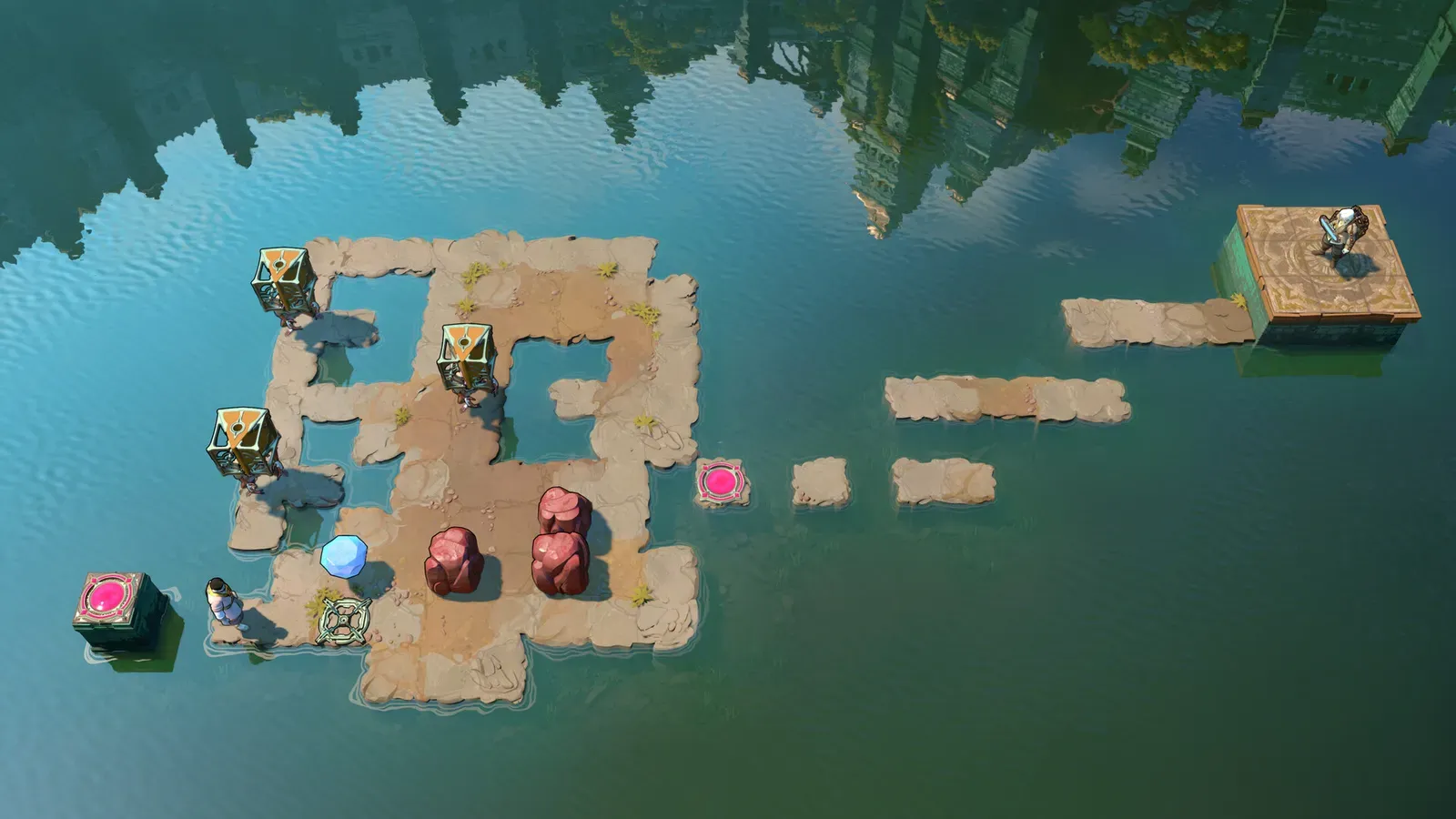
Skipping Stones to Lonely Homes is the southern realm of the Overworld in Order of the Sinking Star. You play a marooned Sailor crossing open water from island to island, and the realm relies on precise route-planning, river redirection and stone-skipping logic. The developers describe analysing where massive skipping stones and rideable lily pads can travel, mapping where stones land across open water, and working out which direction to send lily pads along waterways you have rerouted.
Official source: New Trailer – Explore the Realm (Steam news, September 23, 2026)
This is the realm where you spend the longest looking and the shortest acting. If you like planning a route on paper before touching anything, the south is where that instinct is rewarded most directly.
What Is Skipping Stones to Lonely Homes Realm?
The south route of the Overworld takes you out onto open water. The Sailor is stranded, and the islands around him are the map. What makes the realm its own thing is that the water is not a wall — it is a surface. Things travel across it, and the puzzle is working out how.
Official material credits Skipping Stones to Lonely Homes by Alan Hazelden as part of the design lineage, described as “A serene puzzle game about throwing stones into water to create stepping paths.”
Official source: Order of the Sinking Star official FAQ
This lineage is confirmed, not inferred: the world carries the same name as the source game, and Game File’s Stephen Totilo reports plainly that “the south of the map is based on another Hazelden game, Skipping Stones to Lonely Homes.” The same reporting confirms that all four foundation games were licensed with permission, and that they shared a Sokoban-style grid structure — which is the reason four separate puzzle games could be stitched into one continuous Overworld at all. The tone carries over, too: the source game is described as serene, and that matches the planning-first pace of this realm.
The Sailor and the Open Water Route
The Sailor is a castaway, which matters for how the realm plays. He does not have a boat he can just sail. He has the water, the stones and whatever the islands offer, and his progress depends on turning those into a path.
That framing is why the realm is described in terms of route-planning rather than abilities. There is no power to unlock that makes the water crossable. There is a route to construct, and it exists only once the pieces are in the right places relative to each other.
Three Planning Layers at Once
The developer guidance names three activities, and they stack rather than replace each other. Reading them as a sequence is the most useful way to approach a new stretch of water.
| Planning layer | What the developers describe | What it decides |
|---|---|---|
| Analysing travel | Where massive skipping stones and rideable lily pads can go | Which pieces are usable from where you stand |
| Mapping landings | Where stones land when they cross open water | Which islands the stones connect |
| Routing the water | Which direction to send lily pads along rerouted waterways | Where the platform ends up once the river moves |
Official source: New Trailer – Explore the Realm (Steam news, September 23, 2026)
The order matters less than the interaction. A lily pad’s useful direction depends on where the river has been sent, and where the river can be sent depends on what the stones have opened. Changing one layer invalidates conclusions you drew about the others, which is exactly why the realm rewards planning the whole set rather than experimenting one piece at a time.
Reading Where a Skipping Stone Will Land
A skipping stone in this realm is not a thrown object you aim once. It is a route element, and the developers describe mapping where stones land across open water as a core activity. The stone travels, and its landing point is the information you need.
That means the useful first pass over a new stretch of water is not to throw anything. It is to trace the likely landings and write down which islands each one connects. Only then does it become clear which stone is the key piece and which ones are options.
Because the strokes are ones you choose rather than ones you execute with timing, a mistake here is usually a planning mistake rather than a skill mistake. Backing out and re-planning is normal, not a failure state.
Lily Pads and Rerouted Waterways
The lily pad is the other half of the mechanic, and it is the half that makes the realm distinct. A lily pad is rideable — it is a platform that carries the Sailor — and the developers describe working out which direction to send lily pads along rerouted waterways.
That phrasing puts the emphasis on the water rather than the pad. If the pad follows the water, then redirecting the river is the move that makes the pad useful, and choosing the direction is the decision that follows. The two-layer structure is what produces the realm’s characteristic puzzle shape: you solve the river first, then you solve the route on the water you just rearranged.
There is a small official audio detail worth knowing for this realm. Each playable character has a signature sound, and the Castaway’s is the metal amulet at his neck. It is a minor thing, but it is the kind of cue that tells you the realm is meant to be inhabited rather than abstract.
Hazards: Open Water, Currents and Locked Routes
The south has no monsters and no beams. Its hazards are structural, and the developers name the moving parts directly: massive skipping stones, rideable lily pads and rerouted waterways.
| Hazard | Why it is dangerous | What it forces you to do |
|---|---|---|
| Open water | Divides the map into islands you cannot swim between | Build a route before you travel |
| Waterways you redirect | Changing the flow can strand a planned lily pad journey | Check dependencies before you reroute |
| A stone’s landing pattern | A stone that lands badly connects the wrong islands | Map landings before committing to a crossing |
None of these can be out-skilled. They can only be out-planned, which is what separates this realm from the other three at the level of feel rather than rules.
Why This Is the Most Planning-Heavy of the Four Worlds
All four realms are puzzle games, so none of them is action-driven. The south is still distinct, and the reason is structural.
In the northern realm you act on objects that are in front of you. In the eastern realm you read geometry and commit to a swap. In the western realm you trace beams and manage which ones are lit. In the southern realm the developers describe three interacting planning layers — travel analysis, landing maps and waterway direction — where a decision in one layer changes the valid choices in the others.
That is a dependency graph, not a single mechanic. It is also why the realm is described in terms of precise route-planning rather than a signature ability: the Sailor’s skill is not a power he uses, it is the route he works out in advance. If you find yourself throwing stones to see what happens, you are probably in the wrong mode for this world.
Demo and Pre-Launch Status
The southern realm is not in the demo. The free demo launched on June 15, 2026 and was expanded by the Demo Part 2 update on June 19, 2026, and its playable worlds are the northern Hauling world, the eastern Mirror Isles, and the western Promise as a single level. Skipping Stones to Lonely Homes is absent from all of it: IGN’s preview says that “the southern area, Skipping Stones to Lonely Homes, wasn’t available in the demo at all”, The Gaming Outsider’s demo review notes that the region is unavailable in the demo, and the creators.gg demo campaign brief asks creators to choose from “one of the three worlds that are available”, a list that does not include the south. The demo store page describes its contents only as “a selected portion of the game”.
Where the Southern Realm Connects to the Rest of the Overworld
The south is half of the second Gold Room pairing the developers named. Clearing a Gold Room bridges two realms so their characters stand face to face, and it unlocks the six large dual-combination areas where the puzzle systems interlock. The official example involving this world is the one to watch: the moving crew meets the Sailor’s stone-skipping.
Two structural details shape how you reach that content. Puzzles are entered through tiles on the floor of the Overworld, and the Overworld itself gates progress — press interviews describe having to solve puzzles out there to open new puzzle tiles. Later, the gold tiles are what unlock the diagonal directions of the Overworld, which is when the hybrid areas become reachable at all. That means the southern realm is not simply a place you finish; it is one of the two halves you need before the map stops being four spokes and starts being a grid.
That pairing puts the northern lane-and-order discipline directly on top of the southern planning layers. For how the routes and gateways fit together, read the Overworld map guide and then Gold Rooms explained. The routing rules are broken down further on the skipping stones and river routing page.
Related
Related Articles
guides
Order of the Sinking Star Achievements Guide
Steam confirms Order of the Sinking Star has achievements, but no list is public before launch. What is confirmed, what is not, and what to expect on October 8.
puzzles
Skipping Stones and River Routing in the South World
How skipping stones, rideable lily pads and river redirection work in the southern world, why rerouting order is part of the puzzle, and how to plan reachability.
worlds
Heroes of Hauling Walkthrough: North World Guide
North world walkthrough for the Hearty Heroes of Hauling: the six-hero moving company, push, pull and teleport abilities, and how to chain them.
Was this helpful?
Thanks for the feedback!