Mirror Isles Walkthrough: East World Guide
East world walkthrough for the Mirror Isles: swap places with your reflection, line up angles to project across islands, and the demo level players call the hardest.
FAQ
What is the Mirror Isles in Order of the Sinking Star?
How does the mirror swapping mechanic work?
Why does stepping back from a mirror help?
What should I do when I have more than one mirror?
Is the Mirror Isles level in the demo really the hardest one?
Quick Answer
The Mirror Isles is the eastern realm of the Overworld in Order of the Sinking Star. You play a wealthy Trader crossing a pristine archipelago, and magic mirrors instantly swap you with your reflection — and swap objects with their reflections too. The developers describe the reflection as an active tool, not a passive copy. You line up the angle to project your reflection onto distant islands, and you step back from a mirror to gain distance so you can project farther. With more than one mirror, multiple reflections move at once.
Official source: New Trailer – Explore the Realm (Steam news, September 23, 2026)
The single most useful idea on this page is that the mirror is not a door. It is a targeting system. Once you internalize that, most Mirror Isles rooms stop looking like teleport puzzles and start looking like geometry problems.
What Is the Mirror Isles Realm?
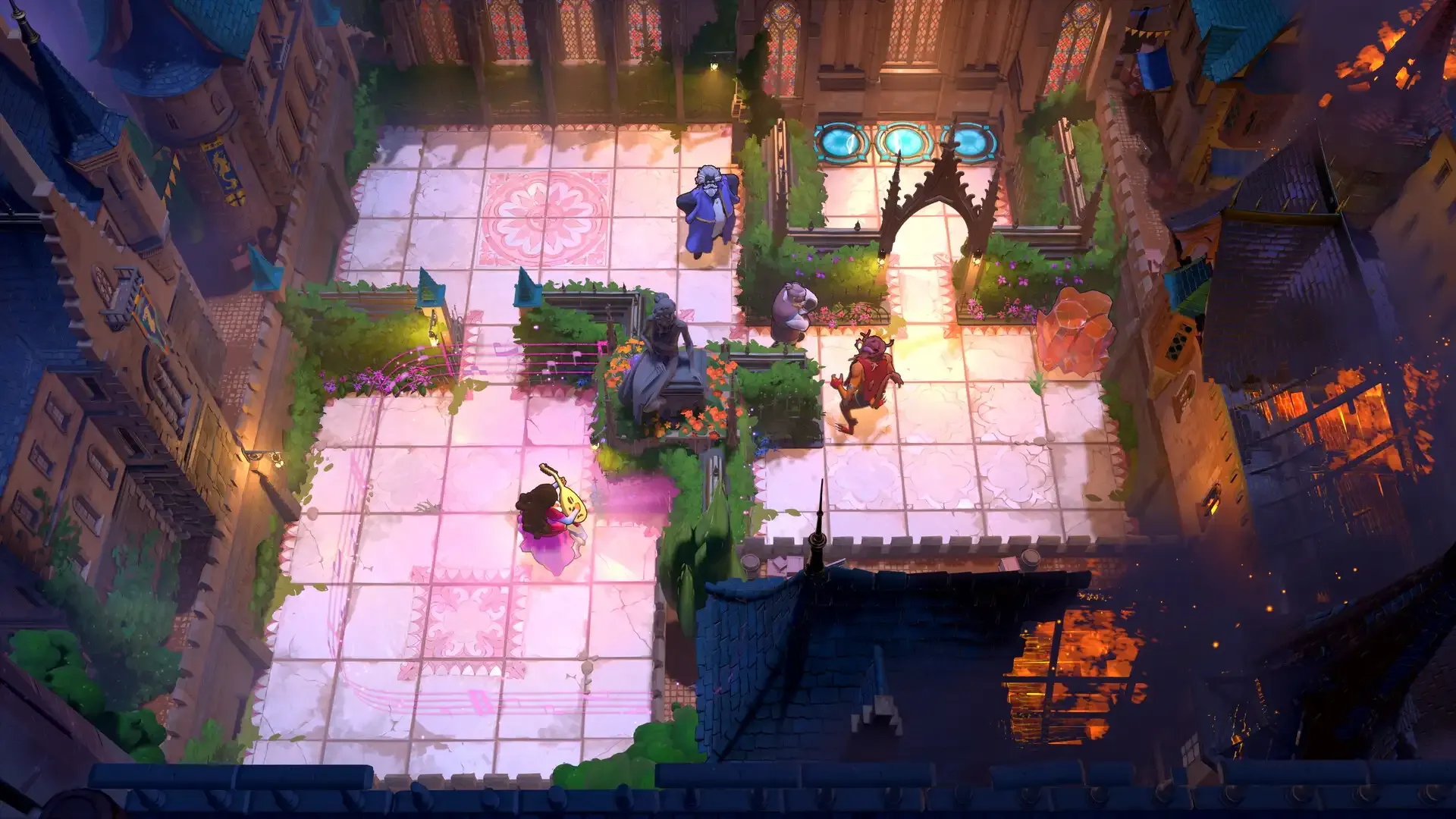
The east route of the Overworld takes you out onto water. The Trader is not a castaway and not an adventurer — he is a merchant with a boat and a route, moving between islands that look untouched. The mechanic that carries the realm is the mirror, and mirrors in this world are not decorative or narrative: they are the puzzle.
Official material credits Mirror Isles by Alan Hazelden as part of the design lineage, describing it as “A clever top-down game focused on swapping places with reflections across islands.”
Official source: Order of the Sinking Star official FAQ
Unlike most lineage claims about this game, this one is confirmed rather than inferred. The world carries the same name as the source game, and Game File’s Stephen Totilo describes being sent “to the greenery in the east, a portion of Sinking Star’s map called The Mirror Isles … based on a 2014 puzzle game called Mirror Isles.” The same report confirms the foundation games were licensed with permission, and that all four of them shared a Sokoban-style grid structure, which is why they could be fused into one Overworld in the first place.
The Position-Swapping Rule
The core rule is a swap, not a teleport. Something is on this side of the mirror and something is on the other side. The mirror exchanges the two positions. Official material applies the same rule to the Trader and his reflection and to objects and their reflections, which means the mechanic is symmetric: whatever works on you works on a crate or a boulder.
That symmetry is where the realm gets its depth. If you move your reflection into a position, you are also moving yourself out of one, and the two consequences are not independent. Rooms are frequently built so that the obvious swap solves the immediate obstacle and creates a worse one two tiles away.
Projecting Your Reflection onto Distant Islands
The reason the Mirror Isles can span open water instead of a single room is projection. The reflection does not have to appear in the adjacent tile. It appears along the line the mirror defines, and it can land on an island that the Trader himself has no way to reach on foot.
The developers describe angle lining as part of the required skill: you align the mirror and the reflection so the reflection resolves where you need it, not merely where it happens to fall. This is the part of the realm that most rewards stopping and looking before you act.
Projection is also how the Trader crosses water. Because the swap exchanges positions rather than moving one actor, putting a reflection on a far island and then swapping is how the Trader gets to a place his boat has not reached yet.
Step Back to Gain Distance
This is the developer insight that players most often miss, and it is worth quoting in the abstract because it reframes the whole mechanic: to project a reflection farther, step back from the mirror.
The logic is direct once you see it. The reflection mirrors your offset from the mirror. If you stand one tile from the glass, your reflection stands one tile from the glass on the far side. Step two tiles back and the reflection is two tiles out. The mirror is a pivot, and your distance from it is a lever on the reflection’s reach.
Practically, this turns mirror placement into a two-variable problem. You are choosing an angle and a standing distance at the same time, and the two interact — moving to change the angle usually changes the distance as well.
Using More Than One Mirror
With a single mirror the technique is a projection. With several, the mechanic escalates into something closer to an army. Press interviews describe the top end of that scale directly: you use more than one mirror to cast more than one reflection and “end up with clones of the character that all move at once.” That is the real depth of the realm, not a bonus gimmick, and it changes the shape of the problem entirely.
| Mirrors in play | What you are solving | What changes when you act |
|---|---|---|
| One mirror | Where a single reflection lands, and what it swaps with | One position pair exchanges |
| Two mirrors | How two reflections relate to each other and to you | Several islands change state from one action |
| Mirror plus object | Which of you, or which crate, ends up where | The tile you vacate becomes the crate’s new home |
| Mirror clones | Which of several clones needs to hold which island | Every clone moves at once, so one action rewrites the whole board |
The developer framing points the same way as the single-mirror lesson: the reflection is an active tool. A second mirror does not add a second puzzle, it multiplies the reach of the first.
Players Report: The Demo Level Everyone Gets Stuck On
The east realm is where the demo’s hardest content sits, according to players rather than the developers. One Mirror Isles level is widely described in Steam discussions and on Reddit as one of the toughest puzzles in the demo, and a separate Reddit thread singles out what players call the 75th mirror puzzle as too hard.
The hints players shared for the level are worth reproducing exactly, because they are unusually specific and they are player advice, not our solution:
Players report: “You need to be on two islands at once. The final island needs to be larger. You can’t leave anyone behind.”
Read those three hints against the mechanics above and they line up with what the developers described. Being on two islands at once is the multiple-reflection layer. The final island needing to be larger points at island state mattering, not just your own position. Not leaving anyone behind is the swap symmetry — you cannot complete the exchange if something is stranded.
For the underlying rules, including why distance from the glass is range, see the mirror and reflection mechanic page.
Where the Mirror Isles Connects to the Rest of the Overworld
The east realm is one of the two worlds confirmed playable in the demo, alongside the northern Hauling world. The demo launched on June 15, 2026, and the Demo Part 2 update on June 19, 2026 added new playable characters, puzzles and areas. Demo progress carries over to the Steam launch version.
One structural rule applies to every realm and to this one: puzzles are entered through tiles on the floor of the Overworld, and the Overworld itself gates progress. Press interviews describe needing to solve puzzles out there to reach new puzzle tiles, which is why a mirror you cannot use yet is often a sign that something else on the map needs attention first.
The realm also feeds directly into the late game. Clearing a Gold Room bridges two realms and unlocks the large dual-combination areas, and the developers named the pairing that involves this world: the Explorer’s light beams meet the Trader’s magic mirrors. Press reporting adds a second, unofficial pairing: the Hauling abilities meeting the Trader’s mirror-hopping, which TheGamer says is titled “Heroes and Mirrors” and opens once the gold tiles unlock the diagonal directions of the Overworld. Only the two official pairings and that press-reported one are public; the remaining combinations are unconfirmed.
If you want the full route picture, read the Overworld map guide and then Gold Rooms explained.
Related
Related Articles
demo
Does Order of the Sinking Star Demo Progress Carry Over?
Yes, officially: demo progress carries over to the launch version on Steam. What that covers, what a launch build could still change, and the north-east skip worry.
demo
Order of the Sinking Star Demo Length and Puzzle Count
The demo shipped with 105 puzzles while official copy says around 110. Playtime reports run from about 4 to 15 hours, and "50 hours" is a misreport.
demo
Order of the Sinking Star Demo Map: Areas and Order
The Order of the Sinking Star demo map explained: which areas the demo covers, the order they open in, and how the community map fits in.
Was this helpful?
Thanks for the feedback!