Heroes of Hauling Walkthrough: North World Guide
North world walkthrough for the Hearty Heroes of Hauling: the six-hero moving company, push, pull and teleport abilities, and how to chain them.
FAQ
What is the Heroes of Hauling world in Order of the Sinking Star?
How many heroes are in the Heroes of Hauling party?
Can I play Heroes of Hauling in the demo?
Is Heroes of Hauling the hardest world?
Do I need to finish Heroes of Hauling before the other worlds?
Quick Answer
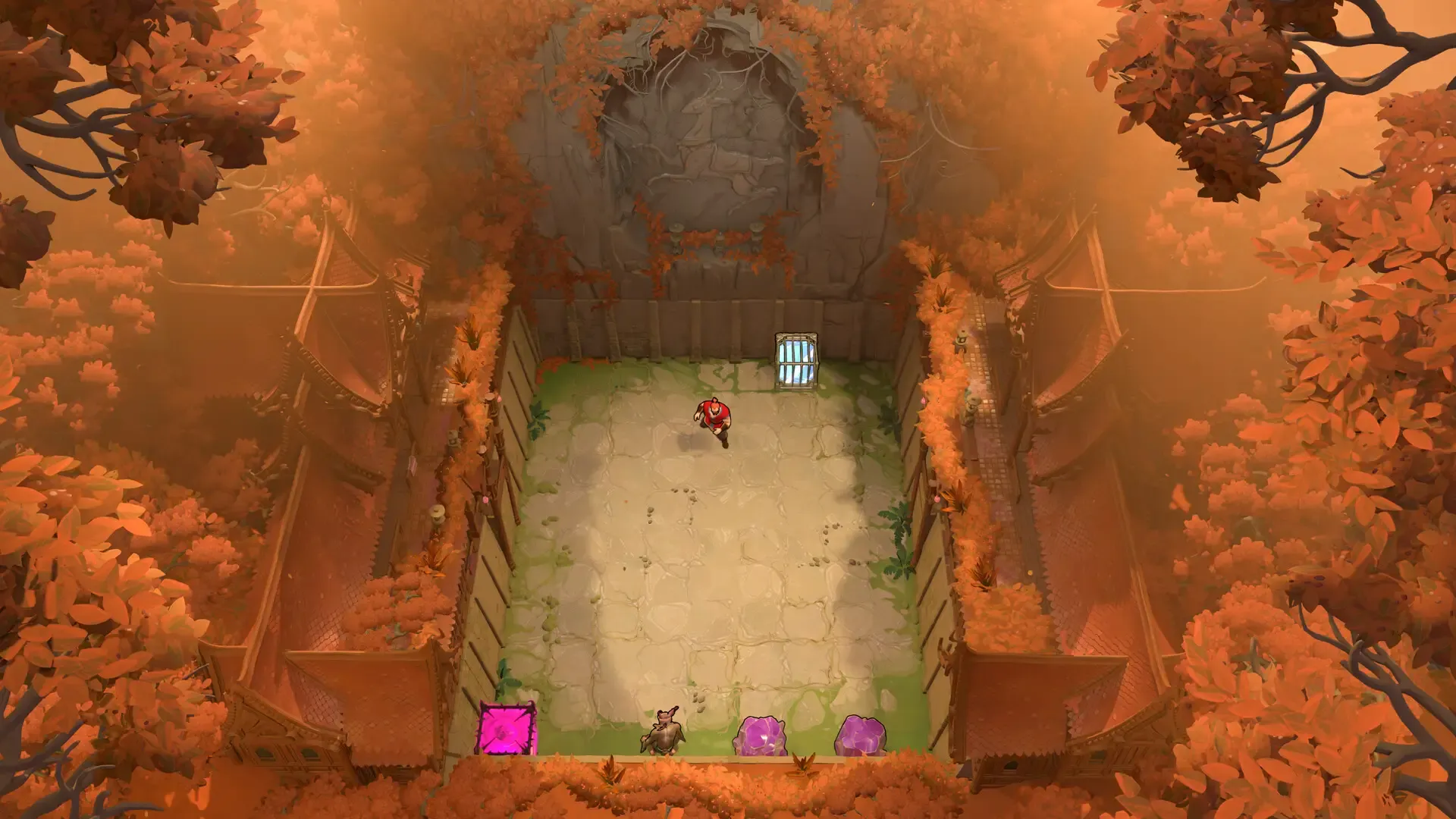
The Hearty Heroes of Hauling is the northern realm of the Overworld in Order of the Sinking Star. It is a band of fantasy adventurers who run a local moving company: Warrior, Thief, Wizard, Bard, Cleric and Druid. Each hero has a unique ability for manipulating objects or navigating a puzzle, and the developers describe using the whole party like a Swiss Army Knife — pushing to clear lanes, pulling to move objects, and teleporting past blockades. The real skill is combining those separate actions into multi-hero chain reactions.
Official source: New Trailer – Explore the Realm (Steam news, September 23, 2026)
Calling it a moving company is not a joke the community invented. It is the framing the developers use for the realm itself, and it explains the whole design: these are working people who move heavy things through a world that keeps putting obstacles in the way.
What Is the Heroes of Hauling Realm?
The north route of the Overworld leads into a fantasy region built on the oldest idea in the game: push a block, make a lane, reach the exit. The twist is that you are not one puzzle-solving avatar. You are a crew.
Each of the six heroes has a distinct way of touching the world. Some of those actions move objects, some move the hero, and the developers are explicit that the interesting part is not any single ability but the sequence you build out of them. Of the four launch worlds, this is the one with the deepest Sokoban lineage, and it shows up in how the rooms are laid out: tight grids, limited floor space, and an exit that only opens once the furniture is in the right place.
The Six Heroes: What Official Material Actually Confirms
Official copy names the six classes and the action vocabulary, but it does not publish a per-hero ability list. Press interviews go further and describe several heroes individually, so the table below keeps the two evidence levels separate rather than flattening them.
| Hero | Individually described action | Evidence level | Official audio detail |
|---|---|---|---|
| Warrior | Pushes objects | Press interview | Leather cuirass creaks |
| Thief | Pulls objects — and always pulls an object beside her, which can trap you | Press interview | Small beads on her bag rattle |
| Wizard | Teleports | Press interview | Not detailed in official material |
| Bard | Charms people and monsters; her music aura changes when she catches someone or something | Press interview plus official | In-game lute built from real lute recordings |
| Cleric | Protects allies | Press interview | Not detailed in official material |
| Druid | Turns everything into stone and back | Player-reported from the demo | Not detailed in official material |
That last row is also the clearest example of a rule this world enforces on you: heroes act on their own if you put them next to something they can use. The Thief will always pull an adjacent object, which can drag a crate into a corner you needed empty. Positioning is therefore a commitment, not a suggestion.
| Named action | What the developers say it does | Where it shows up |
|---|---|---|
| “pushing to clear lanes” | Shoves objects out of the way to open a path | Congested rooms with one usable corridor |
| “pulling to move objects” | Brings objects toward the party so they can be repositioned | Rooms where the crate needs to travel rather than be parked |
| “teleporting past blockades” | Crosses a blockade instead of solving it | Sealed sections the party can reach but not walk into |
Hazards the Developers Name
The north is not a hazard-free toolbox. Official copy mentions vicious monsters, and press coverage explains the rule that makes them interesting rather than merely lethal: you cannot safely stand next to them, but they can be turned against each other. A monster is therefore a movable obstruction with a cost, not just a wall with teeth.
That combines badly, in a good way, with the always-on ability rule. If a hero triggers an action automatically when positioned next to an object, then standing next to a monster is a placement problem as well as a survival problem. The party becomes a set of tools that can hurt you if you leave them in the wrong place.
Why the Party Works Like a Swiss Army Knife
The developer framing is that the party is not six characters with six separate puzzle types. It is one toolkit you unfold. Each hero contributes a verb, and the room is solved by choosing the right verb at the right moment rather than by finding a bespoke gimmick for each hero.
Official copy does single out one ability: the Bard’s music aura, which changes when she catches someone or something in it. Her lute was built as an in-game sample instrument from real recordings of a lute player so that it can start and stop alongside the soundtrack without a crossfade — a small detail that tells you the party members are meant to feel like independent actors rather than menu options.
That is a meaningfully different design from most class-based puzzle games. In a typical party puzzler, the room tells you which character to use because only that character can interact with the key object. Hauling is less generous. Most rooms offer more than one way to move the pieces, and the wasted-move cost of picking the wrong verb is real — you can shove a crate into a corner the party can no longer pull it out of.
The practical habit this creates is to stop before your first action and ask two questions: which hero can touch the blocking object at all, and which hero ends up somewhere useful afterward. The second question is the one that separates a clean solve from a soft-locked board.
Multi-Hero Chain Reactions Are the Real Skill
The developers point at the combination layer as the actual skill ceiling. Knowing what pushing does is the tutorial. Knowing that a push from one hero opens the lane that makes a pull from a second hero meaningful, which in turn puts a third hero in teleport range, is the game.
Chains in Hauling tend to follow one of three shapes:
- Lane into delivery. One hero clears the corridor so another can bring the object through it.
- Delivery into access. The object lands somewhere that opens a path for a hero who could not reach the target before.
- Access into extraction. A teleport drops the party behind a blockade so they can push or pull the piece that was blocking them in the first place.
Because heroes are discrete actors rather than one avatar with a loadout, the order is not cosmetic. Acting with hero B before hero A can put B in a position where the chain no longer closes, and the fix is usually to back out one move rather than to restart the room.
Sokoban Roots and What They Mean for Your Approach
The designers of the source material for this realm are on the record. The official FAQ credits Heroes of Sokoban 1, 2 and 3 by Jonah Ostroff and describes it as “A fantasy-themed puzzle game where you manage distinct hero classes (like warriors and mages) with unique movement and pushing mechanics to reach the exit.”
Official source: Order of the Sinking Star official FAQ
The Steam news post confirms that Hauling is the most Sokoban-derived of the four worlds, and press reporting names the lineage outright rather than leaving it to inference. Game File’s Stephen Totilo wrote that in the north he was “playing Hearty Heroes of Hauling, Thekla’s variation of Jonah Ostroff’s Heroes of Sokoban.” The same report confirms that the four foundation games were licensed with permission, which is why the realm can follow its source as closely as it does.
One credit worth keeping straight: Patrick Traynor, the designer of Patrick’s Parabox, has no world attributed to him in any source, but he worked on this game and on at least one specific northern level — the one with the Wizard among eight large crystal blocks. Miegakure designer Marc ten Bosch and Enigmash designer Zach Polansky are likewise credited as design contributors with no attributed world.
If you have played Sokoban or any of its descendants, the instincts transfer directly. Conserve empty space. Do not push a piece against a wall unless the solution needs it there. Prefer a reversible move while you are still exploring. The party abilities layer on top of those habits, but they do not replace them.
Demo Status: What You Can Play Now
The northern realm is one of the two worlds confirmed playable in the free demo. The demo went live on June 15, 2026 during Steam Next Fest, the Demo Part 2 content update landed on June 19, 2026 with new playable characters, new puzzles and new areas, and the developers confirmed on June 22, 2026 that the demo would stay available longer than Next Fest.
Progress carries over. The official word is that what you make in the demo migrates to the launch version on Steam. The demo is a selected portion of the full game — the store page describes it as “a selected portion of the game, getting a meaningful slice of the over one thousand puzzles” — so treat what you see here as a slice rather than a map of the realm.
Where Hauling Connects to the Rest of the Overworld
Hauling does not stay isolated. Puzzles are entered through tiles on the floor of the Overworld, and the Overworld itself has to be solved to open new tiles — press interviews describe the result as a kind of puzzle-ception, where reaching the next puzzle is its own puzzle. Clearing a Gold Room then bridges two different realms so their characters stand face to face, and it unlocks the six large dual-combination areas where the puzzle systems interlock.
The developers named one pairing directly, and it involves this world: the moving crew meets the Sailor’s skipping stones. Press reporting adds a second pairing that is not in the official copy: a north-east hybrid that GamingBolt frames as the Hauling abilities meeting the Trader’s mirror-hopping, which TheGamer says is titled “Heroes and Mirrors” and is reached after the gold tiles unlock the diagonal directions of the Overworld. Only the two official pairings and this press-reported one are public; the remaining combinations are unconfirmed.
That means the habits you build in the north — lane discipline, order of operations, reversible moves — are meant to be carried into mixed rooms later. Press also notes that early puzzles work on a 2D plane while later puzzles are 3D, so expect the grid to gain a vertical axis as you push deeper. If you want the full picture of how the routes and gateways fit together, start with the four worlds of the Overworld and then read Gold Rooms. The push, pull and teleport vocabulary is broken down action by action on the push, pull and teleport abilities page.
Related
Related Articles
demo
Does Order of the Sinking Star Demo Progress Carry Over?
Yes, officially: demo progress carries over to the launch version on Steam. What that covers, what a launch build could still change, and the north-east skip worry.
demo
Order of the Sinking Star Demo Length and Puzzle Count
The demo shipped with 105 puzzles while official copy says around 110. Playtime reports run from about 4 to 15 hours, and "50 hours" is a misreport.
demo
Order of the Sinking Star Demo Map: Areas and Order
The Order of the Sinking Star demo map explained: which areas the demo covers, the order they open in, and how the community map fits in.
Was this helpful?
Thanks for the feedback!