Order of the Sinking Star Beginner Tips: Your First Hour
What a new player needs in the first hour of Order of the Sinking Star: how the grid works, which world to start in, how to read the art, and how to avoid burnout.
FAQ
Is there a correct order to play the worlds in Order of the Sinking Star?
Which world should a beginner start in?
How long does it take to get unstuck in Order of the Sinking Star?
How many puzzles are in the game?
Do I need to solve everything to finish?
Every world in Order of the Sinking Star is entered through the same hub, and the hub never tells you where to go. That is the design, not a missing tutorial. The first hour is about learning to read the game rather than clearing content.
Quick Answer
Your first hour is orientation, not progress. The Overworld is fully open from the first minute, so there is no correct starting world and no wrong turn. Learn how one move maps to one grid step, sample two of the four routes before you commit to one, and read the art deliberately: lighter ground is walkable. Then stop when the puzzles stop feeling like lessons.
[!tip] Nothing you do in your first hour can break your run. Routes stay open, the map fog only lifts as you make progress, and you can walk back out of any world at any time.
How the grid actually works
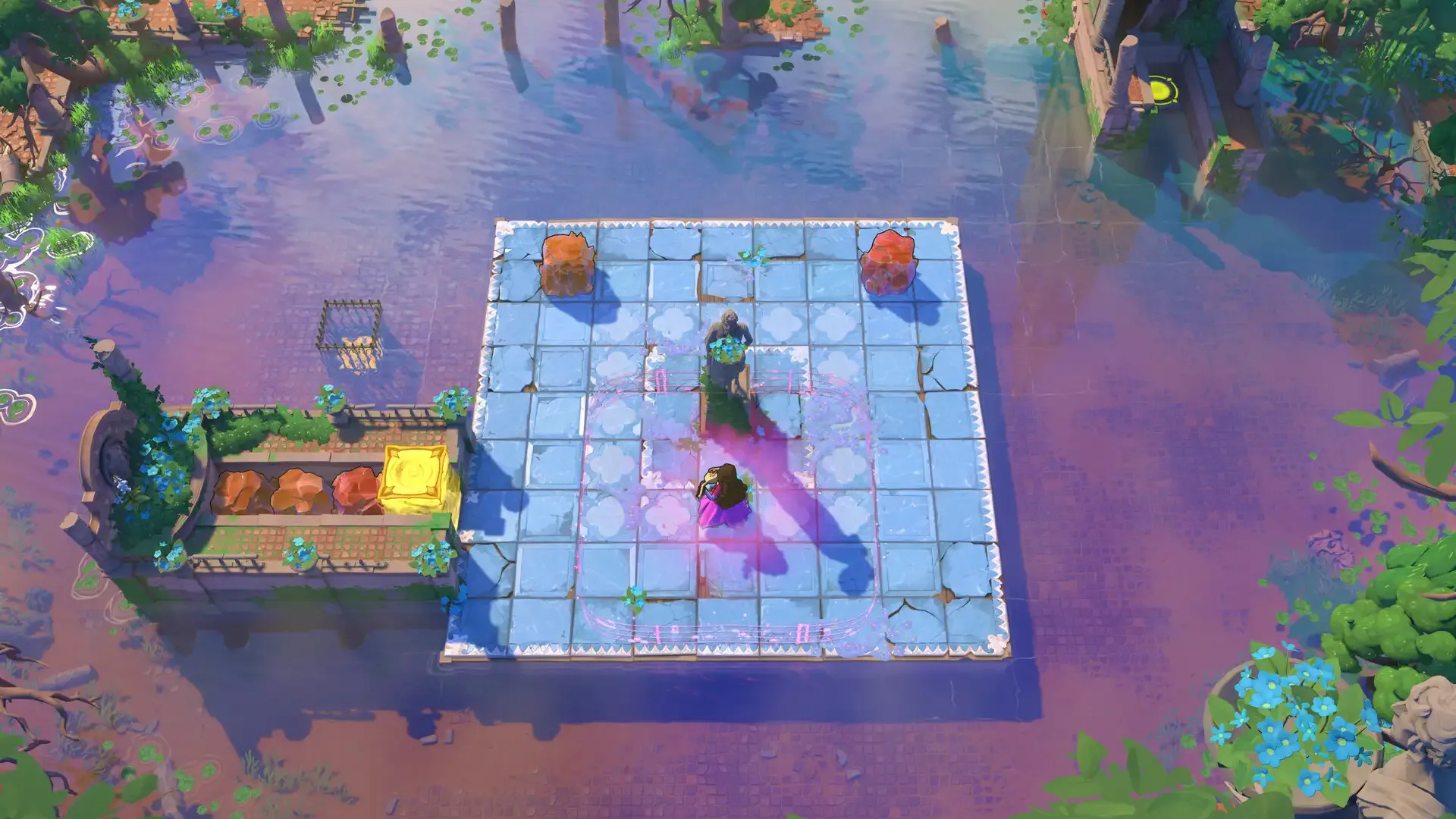
Every world sits on the same foundation: a discrete grid. You move in whole steps, one tile at a time, and the board only changes when you commit to a move. Order of the Sinking Star carries the Sokoban tag on Steam for a reason — pushing, pulling and blocking are the basic verbs, and the space you have to work in is finite and countable.
That countability is what separates a grid game from a movement game. In a shooter, position is continuous and approximate. Here, every tile is either occupied or free, and every action has a definite before and after state. When a puzzle looks impossible, the usual cause is that you have not yet noticed which tiles are permanently fixed: walls, pillars, and background props that read as furniture but never move. How to read a puzzle grid is the transferable skill that pays off in all four worlds.
The practical consequence is that you should think in moves, not in seconds. If a route costs six pushes to set up and the board only gives you five free tiles, the puzzle is telling you to find a different route — not to push harder.
The Overworld is open from the first minute
The central hub is called the Overworld, or the Realm. According to the official Steam news post tied to the “Explore the Realm” trailer, the entire overworld is free to explore from the start of the game, and there is no single correct route through it. Four paths branch off in the four cardinal directions. As you make progress, the map fog clears and exposes larger, more interlinked areas.
This matters more than it sounds. Most puzzle adventures gate the map, so a player who gets stuck has nothing to do but stare at the same board. Here, a stuck player can simply leave. The four worlds were built so that the mechanics overlap later, which means time spent elsewhere is rarely wasted.
Official source: Order of the Sinking Star on Steam
If you want the route logic laid out on one page — how the fog expands, which branches open first, and how the compass maps to themes — that lives in the Overworld map guide.
Which of the four worlds should you start in?
There is no official starting order, so the honest answer is that you should pick by temperament. What follows is a summary of the four routes as the developers have described them, plus who each one tends to suit.
| Direction | World | Lead character | Core mechanic | Start here if |
|---|---|---|---|---|
| North | The Hearty Heroes of Hauling | A fantasy moving company: Warrior, Thief, Wizard, Bard, Cleric, Druid | Pushing, pulling and teleporting past blockades, chained across several heroes | You like assembling combos and using a party as a Swiss Army Knife |
| East | The Mirror Isles | A wealthy Trader sailing a primal archipelago | Magic mirrors swap him with his reflection, and objects with theirs | You enjoy spatial projection and thinking about where a copy can be sent |
| West | The Promise | An Explorer heading alone into the deep | Giant gems channel coloured light beams that unlock phasing, boulder-smashing and long-distance teleport | You like resource routing and combination locks |
| South | Skipping Stones to Lonely Homes | A stranded Sailor moving island to island | Route planning, river redirection and stone-skipping logic | You prefer planning a path before you touch anything |
The demo’s confirmed playable worlds are the northern Heroes of Hauling and the eastern Mirror Isles, so those two are where most new players form their first impressions. The demo walkthrough covers what is and is not included. If you would rather see each world in detail before choosing, the per-world pages are Heroes of Hauling, Mirror Isles, The Promise and Skipping Stones to Lonely Homes.
[!note] Two worlds in the demo, four at launch. The demo is described officially as a selected portion of the game that gives a meaningful slice of the over one thousand puzzles. Its 105 puzzles are widely reported by players, and that figure comes from the community rather than the store page.
Three layers of story, and why no single hero has the full truth
The narrative is delivered by discovery rather than by cutscenes, and the official news post “The Narrative of Order of the Sinking Star” describes three layers.
The first layer is the character tales. Each of the four realms has its own cast, including a thief, a warrior, a wizard and even a talking boat. Those characters begin completely isolated from one another. When you repair the machinery and open a gateway between domains, the characters meet, their personal stories cross, and the game reveals its central narrative idea: no single hero holds the entire truth, and only a merged perspective reconstructs what actually happened.
The second layer is audio logs and environmental lore. These findable logs explain the origin of the Order of the Sinking Star and how the Overworld became what it is, and they double as clues to the larger mystery rather than as optional background colour. Every puzzle is also said to carry its own small story.
The third layer is the Queen’s backstory. Guiding the Queen through each world gradually uncovers her past, her real identity, and why she is trapped in this strange place.
The practical beginner takeaway: if a plot thread feels incomplete, that is expected early on. Another world is holding the other half of it. The point where the layers fuse is the Gold Rooms, where clearing a room bridges two realms and puts their cast members face to face.
Reading the visual language
Art lead Ethan Scheu has described the team’s readability rules directly, and they are worth memorising because they are load-bearing.
Walkable space is separated from background by value: walkable areas tend to sit brighter, while background architecture sits darker. Scale reinforces the same message — background objects and buildings are deliberately miniaturised so they do not read as things you can interact with. Walkable ground is kept clean and the grid stays legible; where the team does add detail, such as grass, stones and sand, it is aligned to grid points so it reinforces the grid rather than hiding it. Lighting and atmosphere then push background noise down further, with restrained fog and camera motion.
Official source: Making of Order of the Sinking Star: Sights and Sounds
Once you internalise that, puzzles get faster. A shiny object at the edge of the play space that is out of scale is decoration. A dull object sitting on the grid at the same scale as you is almost certainly a piece you can move.
How to avoid burning out on a 1000-puzzle game
The audio team designed for long sessions on purpose. There is no looping music in Order of the Sinking Star — the score and ambience are generated dynamically and respond to what you are doing, including how long you have been inside a single puzzle and how active you are.
The key mechanism for a stuck player is the cool-down. When you stop acting, the music fades in intensity, almost to silence. Composer and audio designer Martin Stig Andersen has described an impressionist approach where the emphasis moves from chord progressions to the texture of the chords themselves, which makes the music non-linear: it does not mark the passage of time and does not remind you how long you have been stuck. Sound effects also grow lighter and simpler the longer you work on a hard puzzle, then recover their physicality once you move again after a pause.
[!warning] Do not fight the cool-down. If the music has faded to almost nothing and the board has not changed in a while, the game is telling you that you are tired, not that you are close. Go to another world.
The practical anti-burnout rules for hour one: leave a puzzle after two failed approaches rather than a tenth attempt, keep two worlds open at once so a retreat is always available, and treat a long idle pause as useful thinking time instead of dead time.
First hour checklist
| Step | What to do | Why it matters |
|---|---|---|
| 1 | Move around the Overworld and open all four branches | Confirms the structure is free-roam and removes the fear of a wrong turn |
| 2 | Enter the two demo worlds, Heroes of Hauling and Mirror Isles | These are the routes most players actually see first |
| 3 | Clear the first two or three puzzles in each | Enough to see how each world teaches its own verb |
| 4 | Learn the value rule: brighter ground is walkable | This is the fastest readability win in the game |
| 5 | Identify which props are fixed before planning | Prevents an entire class of false solutions |
| 6 | Note the mechanic each world has introduced so far | Later puzzles reuse earlier lessons instead of repeating them |
| 7 | Leave one world and come back after a session break | Proves the retreat loop works before you actually need it |
| 8 | Let the audio cool down while you think | The score is designed to de-escalate, so silence is a tool |
Related
- How to read a puzzle grid — the transferable reading skill behind every world
- Stuck puzzle checklist — a spoiler-light routine for when you stall
- Overworld map guide — how the four branches and the fog connect
- Gold Rooms explained — what happens when the worlds collide
- Demo walkthrough — what Part 1 and Part 2 actually contain
This page is re-checked at launch, when the full game’s world count, story structure and achievement data become verifiable.
Related Articles
demo
Order of the Sinking Star Demo Map: Areas and Order
The Order of the Sinking Star demo map explained: which areas the demo covers, the order they open in, and how the community map fits in.
puzzles
How to Read a Puzzle Grid in Order of the Sinking Star
A general-purpose method for reading grid puzzles in Order of the Sinking Star: separating interactive tiles from decoration, finding the goal, and counting moves.
worlds
Gold Rooms Explained: Order of the Sinking Star's World Merge
The Gold Rooms make the four worlds of Order of the Sinking Star collide. What clearing one does, the confirmed pairings, and what is still unknown.
Was this helpful?
Thanks for the feedback!