Gold Rooms Explained: Order of the Sinking Star's World Merge
The Gold Rooms make the four worlds of Order of the Sinking Star collide. What clearing one does, the confirmed pairings, and what is still unknown.
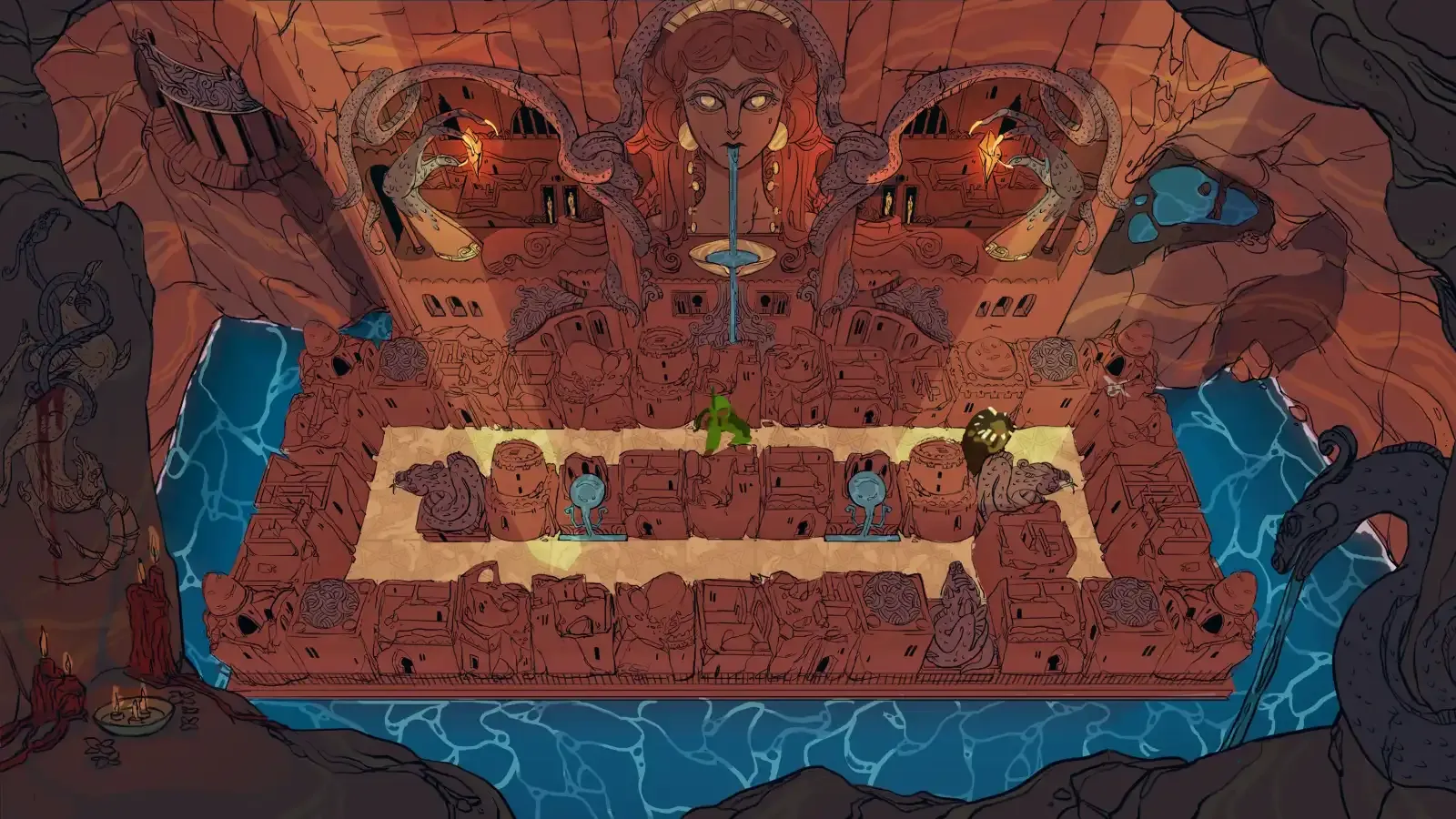
FAQ
What are the Gold Rooms in Order of the Sinking Star?
Which world pairings in the Gold Rooms are confirmed?
How many Gold Rooms are there?
Do I reach the Gold Rooms in the demo?
Why do the Gold Rooms matter to the story?
Quick Answer
The Gold Rooms are the hinge the whole game turns on. Order of the Sinking Star begins looking like an anthology of four independent worlds. Reaching the Gold Rooms triggers a structural shift that makes those worlds collide. Clearing one Gold Room bridges two realms together, brings their characters face to face, and unlocks six large dual-combination areas. Two pairings are officially named: the Explorer’s light beams with the Trader’s magic mirrors, and the moving crew with the Sailor’s skipping stones. A third, North with East, appears in press only. Three remain unpublished.
What are the Gold Rooms?
Thekla’s framing is blunt: the Gold Rooms cause a significant structural change that leads to the worlds colliding. Up to that point, the game plays as four separate stories running in parallel across one shared overworld map. The Gold Rooms are where that separation stops being true.
That is a bigger design statement than it first sounds. A game with four mechanic families and more than one thousand puzzles could have kept them in four sealed boxes and still been enormous. The Gold Rooms exist to break the boxes on purpose, and to make the break part of the plot rather than a bonus mode.
Official source: New Trailer - Explore the Realm
What happens when you clear one Gold Room
Three things happen, and Thekla states all three together: the room bridges two distinct realms, it brings those realms’ characters face to face, and it unlocks six massive dual-combination areas.
Read that as a sequence of consequences rather than a list of features.
- Two realms are bridged. The two worlds stop being separate spaces and start sharing structure.
- Their characters meet. This is the narrative payload. Characters who had no route to each other now have one, and their personal stories can cross.
- Six large dual-combination areas open. These are the puzzle payload: bigger areas where two rule sets are live at the same time instead of one.
Press coverage of the September 23, 2026 trailer frames the same event in almost identical words: completing one Gold Room connects two previously separate regions and creates six larger combination areas where characters and puzzle systems interact.
[!note] The official phrasing is that clearing a Gold Room unlocks “six massive, dual-combination areas”. Press coverage from the same day says completing one Gold Room creates “six larger combination areas”. Both statements agree that one Gold Room produces six areas, not that there are six areas in total across the game.
The confirmed and press-reported pairings
Thekla has published exactly two examples of what combination play looks like, both named in the official materials for the Explore the Realm trailer. Press has described a third.
| Pairing | Worlds combined | What actually combines | Confidence |
|---|---|---|---|
| The Explorer and the Trader | West (The Promise) and East (The Mirror Isles) | Colored light beams that grant phasing, boulder smashing, and long-distance teleports, combined with magic mirrors that swap positions with reflections | Confirmed by Thekla |
| The moving crew and the Sailor | North (The Hearty Heroes of Hauling) and South (Skipping Stones to Lonely Homes) | Six hero classes with push, pull, and teleport abilities, combined with skipping stones and river routing | Confirmed by Thekla |
| The crew and the Trader | North and East | Heroes of Sokoban-style pushing, pulling, and teleporting colliding with mirror-hopping. Press names this hybrid region Heroes and Mirrors | Press only, absent from official copy |
| North and West | Not published | Not published | Not announced as of September 24, 2026 |
| East and South | Not published | Not published | Not announced as of September 24, 2026 |
| West and South | Not published | Not published | Not announced as of September 24, 2026 |
The two confirmed examples are chosen well as illustrations, because they demonstrate two different kinds of collision. The Explorer and Trader pairing is a collision of two positional systems: beams that project force across a space, and mirrors that relocate bodies within that space. The crew and Sailor pairing is a collision of logistics: a party that manipulates objects on solid ground, and a navigator who manipulates where the ground effectively is.
The third row is a different kind of claim and is labelled as such. GamingBolt raises the matchup directly, asking what happens when the abilities of the Hearty Heroes of Hauling meet the Trader’s mirror-hopping, and TheGamer goes further by giving the hybrid region a name, Heroes and Mirrors, described as a world combining elements and mechanics from both the hero and mirror worlds. Both are press, neither appears in Thekla’s own copy, and a press write-up is not the same thing as a published pairing list.
What all three known pairings have in common is the design intent. The puzzle value is not that two mechanics sit side by side. It is that each one changes what the other one can reach.
Why six? Because four regions have six borders
The number six stops being a mystery once you look at the map as a map. Game File’s explanation is that the combination effects cluster at the six borders where the four regions touch. The example given is the northeast border, where the gameplay systems based on Heroes of Sokoban cross over with the rules governing The Mirror Isles.
That reframes the whole feature. The Gold Rooms are not six arbitrary bonus dungeons bolted onto the side of the game. They are the places where two regions are adjacent, and adjacency is what makes a hybrid rule set possible.
It is also worth separating two published statements that get blended together in summaries:
- Thekla’s own copy distinguishes the Gold Rooms, which are the trigger, from the six dual-combination areas that clearing them unlocks.
- “Six Gold Rooms” is press and community shorthand for the same feature. It implies six discrete rooms, which may or may not be how it is structured, and no official list of six rooms exists.
[!warning] Do not present “there are six Gold Rooms, one per world pairing, and each unlocks one combination area” as established fact. The count of six is well supported. The internal structure is not. Press coverage says six Gold Rooms, Game File says six borders, Thekla says six dual-combination areas unlocked per cleared room. Those three statements are compatible but they are not the same statement, and this article will not merge them for you.
Gold tiles, diagonal directions, and what a hybrid actually looks like
The unlock path on the map is described as gold puzzle tiles. Progress through each world opens new overworld paths, and the gold tiles are where the worlds blend together. TheGamer’s account adds a detail the trailer does not: the gold tiles open up the diagonal directions of the overworld, which is a neat way of saying the four cardinal routes are only the beginning of the map’s geometry.
The same account gives the clearest picture anywhere of how a hybrid room plays. In one example, half the screen is the character with the mirror and the other half is the wizard with his teleportation magic, and you have to use both characters to help one another. That is the practical meaning of a dual-combination area: two rule sets, two characters, one solution that neither could produce alone.
Official source: Order of the Sinking Star news hub — Thekla describes the hybrid zones as intertwining “entire narrative threads and puzzle systems”, creating multi-layered possibilities that prove there is far more to the Overworld than meets the eye.
What the combination areas contain after the merge
A December 2025 preview described the post-merge structure in more detail than anything published since. As described there, completing the four worlds is roughly the first five percent of the game. The combination areas then take over and contain big star puzzles that fill a meter. Filling a meter to 7 out of 10 opens a teleporter to the endgame island, four of the six teleporters are required to reach the endgame, and 10 out of 10 in all six is what full completion asks for.
[!warning] That structure comes from December 2025 preview reporting, not from the launch build, and Thekla has not restated it since. Read it as intent, not as confirmed launch structure. This page is re-checked at launch.
Even with the caveat, the shape tells you something about why the Gold Rooms are positioned where they are. The merge is not the ending. It is the point where the game switches from four parallel campaigns into a completion economy driven by six parallel objectives, and the story and the 100 percent bar deliberately come apart.
Blow’s line: “two of these worlds open at once”
The earliest concrete description of the mechanic came from Jonathan Blow in December 2025, well before the trailer.
“What this gold room does is it brings together the worlds for the first time… You have two of these worlds open at once” — Jonathan Blow, in GamesBeat’s interview
That phrasing is the cleanest one-sentence explanation available. The Gold Room’s function is not to add a mechanic. It is to have two worlds simultaneously active, which is exactly the condition the game has avoided for its first stretch.
It also tells you why the Gold Rooms are expensive, design-wise. A game that never combines mechanics only has to verify each world’s rules against itself. Two worlds open at once means every interaction between two rule sets has to hold up, and there are six possible pairs of worlds.
The earlier player description: “gold puzzle tiles”
Months before the September 2026 trailer, players were already describing the mechanic in the language of the overworld map rather than the language of rooms.
“As you progress through each world, you’ll be able to open new overworld paths and unlock special gold puzzle tiles where the worlds blend” — early player description quoted on r/TheWitness
The “gold puzzle tiles” phrasing is worth keeping because it describes the map-level experience: gold markers on the overworld where the boundary between two worlds stops mattering. It is a player description, and as of September 24, 2026 it has not been contradicted by anything official. It also lines up with what the trailer later described as rooms.
Why the Gold Rooms matter narratively
The Gold Rooms are not a systems feature with a story bolted on. They are the mechanism that makes the story’s central claim possible.
Thekla describes the narrative as discovery-driven, with no passive cutscenes interrupting play. It is built in three layers, and the first layer is the one the Gold Rooms serve directly. Each of the four realms has its own characters, and at the start those characters are completely isolated from each other. Their individual stories cross only when you repair mechanics and open gateways between domains. The point of that crossing is explicit: the game is built so that no single hero holds the full truth, and only a merged perspective can assemble the real history.
That structure does not work without a merge event. If the four casts never met, the game would be four short stories in one box. The Gold Rooms are the event that lets characters cross over, which is precisely what makes the “no single viewpoint is complete” design pay off instead of staying a theme statement.
The other two narrative layers reinforce the same shape. Hidden audio logs reveal the origin of the Order of the Sinking Star and how the Overworld came to be, and they are functional clues rather than background flavor. The Queen’s backstory unfolds as you guide her through each world, revealing her past, her real identity, and why she is trapped here. Both layers get more useful as the map becomes legible, and it only becomes fully legible once the worlds collide.
Press coverage makes the same connection more plainly: combining mechanics also lets the denizens of each region interact with each other, and that interaction is how you may discover exactly what is going on.
How you reach the Gold Rooms
The published description is deliberately vague on routing, and it is worth being honest about that rather than inventing a route. What is stated is that you reach the Gold Rooms by progressing through the worlds, that progress opens new overworld paths, and that the gold tiles are unlocked in the process. How you reach any individual one is, in the words of the same coverage, completely up to you, because the entire overworld is free to explore from the start.
So the practical model is: keep solving, keep opening paths, and expect the map to change shape when a Gold Room is involved. There is no published list of prerequisites, no published area count, and no published order.
For the map-level structure that surrounds all of this, see the overworld map guide. For the two worlds named in the confirmed pairings, the Mirror Isles walkthrough and The Promise walkthrough cover the mechanics before they merge.
What has not been announced
This is the part most pages skip, so here it is plainly. As of September 24, 2026, the following are not public:
- The remaining three pairings. Thekla named two examples and stopped, and press added a third without official confirmation. No official material identifies which world pairs with which of the remaining three combinations.
- A numbered Gold Room list. Six is well supported as a count, but no official numbering, naming, or ordering exists, and the “six rooms” and “six areas” statements have never been reconciled in public.
- What the six dual-combination areas contain. They are described as massive and dual-combination. Their contents, sizes, and puzzles are unpublished.
- Where the Gold Rooms sit on the overworld. No map has been published showing their placement.
- Whether a Gold Room is one puzzle or a room containing many puzzles. Both readings fit the published wording.
- Whether the demo contains a complete Gold Room. The Part 2 update says players get “a chance to see what happens when the worlds start to collide”, which is a teaser, not a confirmation of a full Gold Room.
Articles that claim to list all six pairings are inventing them. The honest count of officially named pairings is two.
What to expect at launch
The Gold Rooms will sit late, because they require at least two worlds to be developed and the game deliberately withholds the collision. They will be map events as much as puzzle events, because clearing one is described as opening new paths and new areas rather than as a reward screen. And they will matter narratively, because the story’s stated payoff depends on characters from separate realms meeting.
Everything past that is speculation. This page is re-checked at launch, and the three unnamed pairings will be filled in only when Thekla or the game itself states them.
Related
Related Articles
characters
The Trader: Order of the Sinking Star's Mirror Isles Hero
The Trader is the Mirror Isles protagonist: a wealthy merchant whose magic mirrors swap him and objects with their reflections. Here is what the devs confirm.
demo
Order of the Sinking Star Demo Map: Areas and Order
The Order of the Sinking Star demo map explained: which areas the demo covers, the order they open in, and how the community map fits in.
guides
Order of the Sinking Star Beginner Tips: Your First Hour
What a new player needs in the first hour of Order of the Sinking Star: how the grid works, which world to start in, how to read the art, and how to avoid burnout.
Was this helpful?
Thanks for the feedback!