How to Read a Puzzle Grid in Order of the Sinking Star
A general-purpose method for reading grid puzzles in Order of the Sinking Star: separating interactive tiles from decoration, finding the goal, and counting moves.
FAQ
How do I tell which tiles I can interact with?
What is the difference between a teaching puzzle and a test puzzle?
Why do the same tiles behave differently later in the game?
How do I count moves in a grid puzzle?
What is an invariant in a puzzle?
Grid puzzles reward a specific habit: reading the board before playing it. Order of the Sinking Star is built from four different designers’ systems layered onto one shared grid, which makes that habit more valuable here than in a single-mechanic puzzle game.
Quick Answer
Read a grid in five passes. Separate the interactive layer from decoration. Name the goal, the exit and the blocker. Decide whether the board is teaching a new interaction or testing one you know. Count the moves the solution should take. Look for symmetry and invariants. Only then start planning, and re-read the goal after every failed approach.
[!tip] The single highest-return habit is naming the goal in one sentence before you move. Most stalls come from solving a problem the board did not ask.
Why the same grid can support several mechanics
Order of the Sinking Star was assembled using what the developers call a game design supercollider: four foundation games by other designers were collided, and the combinations were allowed to multiply. The practical result is that a tile is not defined by its shape. It is defined by which world’s rule set is currently governing it.
Early in the game that distinction is invisible, because each world teaches in isolation. The northern world is Sokoban-descended pushing and pulling, chained across a party of heroes. The eastern world is position-swapping with reflections. The western world routes coloured beams through gems. The southern world is route planning across water. Each has its own vocabulary, and each looks like a self-contained game.
Then the worlds collide in the Gold Rooms, and two rule sets share a board. The developers have named two of the six pairings: the Explorer’s light beams crossed with the Trader’s magic mirrors, and the moving company crossed with the Sailor’s stone-skipping. When that happens, a tile you learned to read in one world can be acting under the other world’s rules — and your old reading of it becomes a liability rather than an asset.
That is the argument for learning to read grids rather than memorising puzzles. A memorised solution has no value when the rules underneath it change.
Pass one: separating the interactive layer from decoration
The art team has described its readability technique plainly, and it is the single most useful piece of information a new player can have.
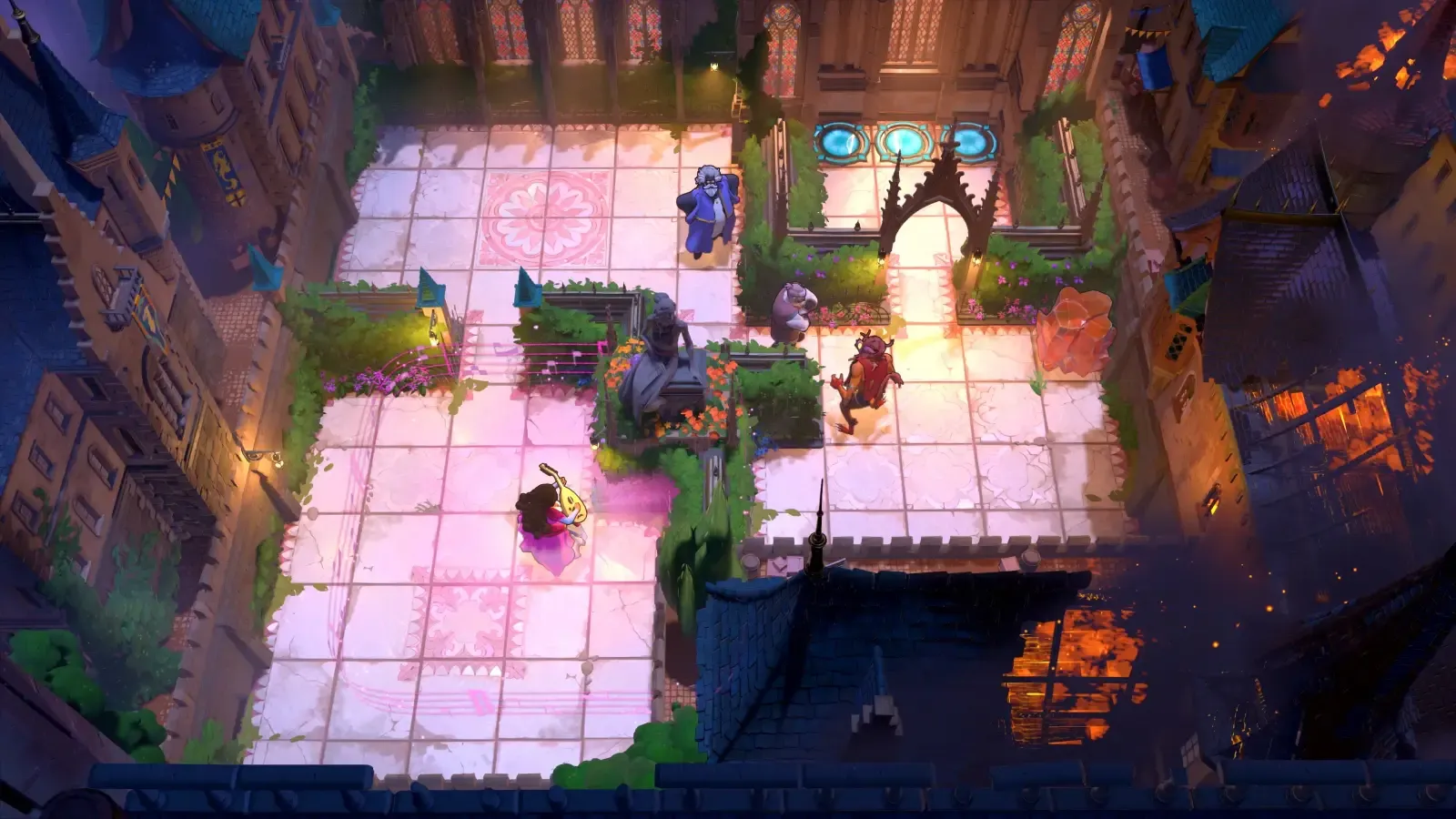
Walkable areas are separated from background by value: walkable ground tends to read brighter, while background architecture sits darker. Scale reinforces the message, since background objects and buildings are deliberately miniaturised so they do not look like things you can interact with. Walkable ground is also kept clean, and where detail is added — grass, stones, sand — it is aligned to grid points, which reinforces the grid instead of hiding it. Lighting, atmosphere, drifting fog and camera motion are all restrained for the same reason: to keep background noise low.
Official source: Making of Order of the Sinking Star: Sights and Sounds
Turn that into a procedure. First, identify the brighter region — that is where you can go. Second, ignore anything at the wrong scale, because it is there to look at. Third, look for objects that sit on the grid at the same scale as the actor you control, because those are the candidates for movement.
The technique tells you about walkability, not about pushability, and the gap between those two is where a lot of false assumptions live. A prop can be walkable-to and still immovable, and a dull, low-detail object can be the most important thing on the board. Classify on purpose, and test anything you are unsure about with one cheap move rather than building a plan around it.
Pass two: naming the goal, the exit and the blocker
Most grid puzzles contain three functionally different targets, and beginners routinely collapse them into one.
The goal is what the board actually requires. This might be a receiving tile, a shape that must be completed, a character that must arrive somewhere, or a beam that must be lit. The exit is where the actor ends up when the puzzle is done, which is not always the same as the goal — some boards want an object delivered, not the actor moved. The blocker is whatever prevents the goal from being reached right now: a wall, a locked door, an occupied tile, an object that must be relocated first.
Naming all three separately exposes the shape of the solution. If the goal and the exit are different, the puzzle is about moving something other than yourself, and your own movement is just the mechanism for pushing. If the blocker is a single object, the puzzle is usually about where that object must be parked, not about the route to the exit.
Pass three: teaching puzzle or test puzzle?
Puzzle games teach in small rooms. When a designer introduces a new interaction, the standard move is to strip the board down to the minimum needed to demonstrate it, then let the player try it in a safe space before asking for execution under pressure.
That gives you a reliable tell. A sparse board means a short solution. If a puzzle gives you three objects and a wide-open floor, it is probably not asking for a fifteen-move plan. It is asking what single thing those three objects can do together.
Test puzzles look different: they give you roughly what your plan needs, which makes the board feel dense and the possible plans feel interchangeable. When you are stuck in a test puzzle, the problem is usually sequencing or resource use rather than comprehension. When you are stuck in a teaching puzzle, the problem is almost always that you have not identified the new interaction.
Pass four: counting moves
On a discrete grid, solutions are countable, and counting is a diagnostic tool rather than a puzzle-solving trick.
Start from the finish state and work backwards. How many distinct objects must end somewhere different from where they started? How many tiles must be freed for the last piece to move through? How many steps does the final object need to reach its destination? That total is a floor, not an exact answer, but a floor is enough to tell you whether your current approach is in the right order of magnitude.
Counting also exposes wasted moves. Grid mechanics punish unnecessary actions severely because a single unwanted push can seal a corridor permanently. If your plan uses more moves than the floor requires, the extra moves are almost certainly the ones causing the failure, and the fix is usually to find the sequence that avoids them rather than to execute your plan more carefully.
Pass five: symmetry and invariants
Before committing to a long plan, look for structure that cannot change. Two categories matter.
Symmetry is the easier one. Boards are often mirrored, rotationally symmetric, or built from repeated units, and the symmetry usually encodes something about the intended solution — a symmetric board often wants a symmetric order of operations, or it reveals that acting on one side changes the other.
Invariants are the more powerful one. An invariant is a quantity or relationship that no legal sequence of moves can alter, such as the parity of a count, the fact that a push always displaces two things at once, or the rule that a swap exchanges positions without creating or destroying anything. Invariants tell you which goals are reachable before you spend moves discovering that they are not. If the goal requires changing something invariant, the goal needs a different mechanism than the one you are using.
What to look at, in what order
| Order | What to look at | What you are deciding |
|---|---|---|
| 1 | Brightness and scale | Which region is walkable, and which props are decoration |
| 2 | The goal | What the board actually requires, stated as a verb and an object |
| 3 | The exit versus the goal | Whether you are moving yourself or something else |
| 4 | The blocker | What specifically stands between the current state and the goal |
| 5 | Tile census | Movable, fixed, decorative — three lists, tested not assumed |
| 6 | Board size and density | Whether this is a teaching puzzle or a test |
| 7 | Move floor | The minimum moves the finish demands, and the space available |
| 8 | Symmetry and invariants | Which goals are reachable at all |
| 9 | Prior mechanics | Which world’s rule set this board is actually using |
Practising it across the worlds
The reading skill transfers because the underlying grid is shared. If you want to train on one world at a time, the per-world pages are Heroes of Hauling for pushing and party chaining, Mirror Isles for position swapping, The Promise for beam routing, and Skipping Stones to Lonely Homes for route planning.
Two habits make the practice stick. Read the board before every attempt, even when you think you already know it — the second pass often catches the tile you misclassified. And when a reading fails, write down which pass failed rather than which move failed. That is the difference between getting better at this game and getting better at puzzle games generally, and it is what makes the habit survive the worlds colliding.
If you are stuck right now rather than studying, the stuck puzzle checklist turns the same five passes into a diagnostic routine. If you are starting from scratch, beginner tips for the first hour and the demo walkthrough are the softer on-ramp.
Related
- Stuck puzzle checklist — the same method as a diagnostic routine
- Beginner tips and first hour — how to start without burning out
- Overworld map guide — where each reading style is taught
- Gold Rooms explained — what changes when two grids share rules
- Mirror and reflection mechanic — a deep dive on the eastern world’s rule set
This page is re-checked at launch, when the post-collision combination boards become verifiable.
Related Articles
characters
The Trader: Order of the Sinking Star's Mirror Isles Hero
The Trader is the Mirror Isles protagonist: a wealthy merchant whose magic mirrors swap him and objects with their reflections. Here is what the devs confirm.
guides
Order of the Sinking Star Beginner Tips: Your First Hour
What a new player needs in the first hour of Order of the Sinking Star: how the grid works, which world to start in, how to read the art, and how to avoid burnout.
puzzles
Gem Light Beams and Colour Abilities in The Promise
How giant gems and coloured light beams work in the western caves, the three abilities the developers name, and why the colour-to-power mapping is still unconfirmed.
Was this helpful?
Thanks for the feedback!